Artificial Intelligence is no longer something reserved for engineers, researchers, or tech companies. It is becoming a core skill for everyone — from operational staff and managers to executives and founders.
Recently, I was deeply inspired by Vivian Balakrishnan during his speech at the Singapore AI Engineer event on 16 May 2026. One message stood out clearly:
We cannot afford to only observe AI from the sidelines. We need to experience it ourselves.
That idea stayed with me.
Not everyone needs to become a machine learning engineer. But everyone should understand how AI works, what it can do, where it struggles, and how it can transform the way we work.
The best way to learn AI is not by reading another article or watching another video.
It is by building something yourself.
That was the reason I decided to create my own AI chatbot.
And surprisingly, I did not need to write complicated code.
Why Building Your Own AI Chatbot Matters
Today, AI tools are everywhere:
- ChatGPT
- Claude
- Gemini
- Copilot
- Perplexity
Most people use them as end users.
But there is a huge difference between:
- using AI tools, and
- understanding how AI systems are built.
Once you build your own chatbot, several things suddenly become clear:
- How AI models think
- How prompts influence outputs
- How memory works
- How AI retrieves knowledge
- How automation connects together
- How agents can execute tasks autonomously
More importantly, you start seeing possibilities inside your own work.
A manager may imagine:
- AI assistants for reporting
- Internal knowledge bots
- Automated meeting summaries
A sales leader may think about:
- Customer support agents
- Lead qualification bots
- CRM automation
An operations team may discover:
- AI workflow automation
- Internal SOP assistants
- Incident response copilots
The barrier to entry is now dramatically lower than before.
And that is exactly why this is the perfect time to start experimenting.
Why I Chose n8n
When exploring tools to build my chatbot, I wanted something that was:
- beginner-friendly
- visual
- scalable
- flexible
- future-proof
That led me to n8n.
n8n is a workflow automation platform that allows you to connect applications, APIs, AI models, databases, and business logic visually.
What makes it especially powerful for AI is this:
You are not just building a chatbot. You are building an AI system.
Today, it may start as:
- a simple Q&A chatbot
Tomorrow, it can evolve into:
- AI agents
- multi-step reasoning workflows
- autonomous task execution
- tool-calling systems
- document analysis pipelines
- business process automation
This “agentic AI” direction is where the industry is moving rapidly.
And n8n gives you the flexibility to grow into that future gradually.
Without needing to become a full-time software engineer.
The Core Stack I Used
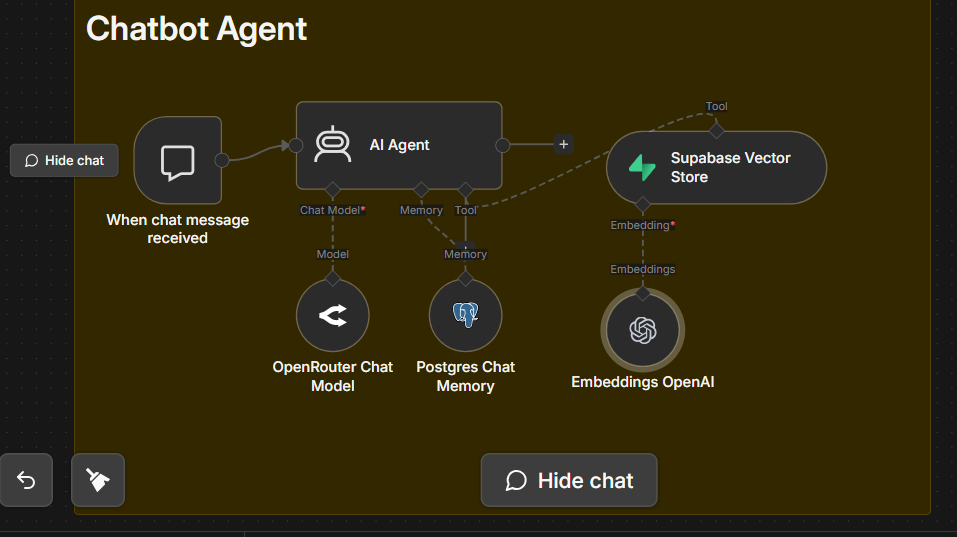
Here are the main components I recommend if you want to build your own no-code AI chatbot.
1. Host Your Own n8n Instance
I personally recommend Hostinger to host your n8n server.
Why?
- affordable
- beginner-friendly
- easy deployment
- reliable enough for personal AI projects
You can get started for around USD $8/month, which is surprisingly accessible for running your own AI workflows.
Self-hosting also gives you:
- more control
- better flexibility
- easier scaling later
- ownership of your automation stack
Think of it as building your own AI laboratory.
2. AI Model API — Use OpenRouter
For AI models, I strongly suggest using OpenRouter.
What makes OpenRouter powerful is the flexibility.
Instead of being locked into a single provider, you can access:
- OpenAI models
- Anthropic Claude
- Google Gemini
- DeepSeek
- Mistral
- Llama models
- and many others
Some models are even free to experiment with.
This is extremely useful when you are learning because:
- you can compare outputs
- test different reasoning styles
- optimize costs
- experiment quickly
As AI evolves rapidly, having model flexibility becomes a major advantage.
3. Setup RAG with Supabase
To make your chatbot truly useful, you need memory and knowledge retrieval.
This is where RAG (Retrieval-Augmented Generation) becomes important.
RAG allows your chatbot to:
- search documents
- retrieve internal knowledge
- answer based on your own data
- reduce hallucinations
For this, I recommend Supabase as the vector database solution.
Supabase is excellent because:
- easy to start
- developer-friendly
- scalable
- integrates nicely with n8n
- supports vector search capabilities
You can store:
- PDFs
- company SOPs
- notes
- documentation
- meeting transcripts
- knowledge bases
And your chatbot can intelligently retrieve relevant information before generating answers.
This transforms your chatbot from:
a generic AI assistant
into:
your personalized AI knowledge companion.
4. Give Your AI Agent Web Search Capability
A chatbot becomes far more useful when it can access real-time information.
For this, I recommend SerpApi.
SerpApi allows your AI agent to:
- search the web
- retrieve live information
- gather updated data
- answer current-event questions
This is especially useful for:
- research agents
- market intelligence
- competitive analysis
- news monitoring
- dynamic workflows
In agentic AI systems, tools matter.
The future is not just AI generating text.
The future is AI:
- reasoning,
- searching,
- retrieving,
- deciding,
- and taking action.
What Excites Me Most About This Journey
The most exciting part is not the chatbot itself.
It is the mindset shift.
Once you realize you can build AI systems yourself, even without deep coding expertise, your perspective changes.
You stop seeing AI as:
- a mysterious black box
And start seeing it as:
- a practical tool you can shape around your work and ideas.
That is incredibly empowering.
Especially in a world where AI capabilities are accelerating every month.
Final Thoughts
You do not need to become an AI expert overnight.
But you should start exploring.
The people who learn AI early — regardless of their role — will likely have a major advantage in the coming years.
And the best way to start is simple:
Build something small.
Experiment.
Break things.
Learn by doing.
Your first chatbot does not need to be perfect.
It only needs to begin.
Leave a Reply